
Stripe Alternatives for SaaS (2026): Replace Billing, Tax or the Whole Stack


The best Stripe alternatives for SaaS in 2026, grouped by what you replace: Stripe Billing, tax and seller liability, or the payment processor itself.
Stripe Alternatives for SaaS (2026): Replace Billing, Tax or the Whole Stack
Updated October 2026. Pricing checked on each vendor's own site.
TL;DR:
Replace Stripe Billing (keep Stripe for payments)
- Comecero: billing and checkout on your own processor (2% + $0.20), or fully managed (4.9% + $0.40).
- Chargebee: subscription billing with usage pricing on its Flow plan.
- Recurly: $249/month, with the first $40K of monthly billings free of its percentage fee.
- Maxio: billing plus revenue reporting for B2B finance teams, from $599/month.
Replace the tax and seller burden (merchant of record)
- Paddle: 5% + 50¢ all-in, built for scaling SaaS.
- FastSpring: mature MoR for software sellers, quote-based pricing.
- Lemon Squeezy: simplest MoR start, owned by Stripe.
- Polar: developer-first MoR with tiered pricing from free to $400/month.
Replace the processor
- Adyen: interchange-plus pricing for high-volume, global businesses.
- Braintree: PayPal's processor, now branded PayPal Enterprise Payments.
The useful question isn't "what's better than Stripe?" It's "which part of Stripe isn't working?" If Stripe Billing is too limited or too expensive at your volume, swap the billing layer and keep Stripe processing payments. If VAT and sales tax registrations are the headache, a merchant of record takes over the seller role for those sales. Changing the processor itself is the biggest move, and usually only worth it at serious volume.
Most SaaS teams that leave Stripe are reacting to one of three things: fees that stack (2.9% + 30¢ plus Billing, Tax, international and currency fees, broken down in our Stripe fees guide), the work of registering and filing tax in every market, or billing features that don't fit how they price. Each points to a different group below.
Stripe alternatives compared at a glance
| Tool | What it replaces | Pricing (Oct 2026) | Keeps Stripe? | Handles tax as seller? | Best for |
|---|---|---|---|---|---|
| Comecero | Billing (or the whole stack) | 2% + $0.20 own processor; 4.9% + $0.40 managed | Yes, on Billing | Handles taxes on Express | Keep-your-processor or fully managed |
| Chargebee | Billing | Usage pricing on Flow and Enterprise | Yes | No | Seats + usage subscriptions |
| Recurly | Billing | $249/month, plus 0.9% on billings above $40K | Yes | No | Subscription retention and recovery |
| Maxio | Billing | $599/month up to $100K billings | Yes | No | B2B finance and revenue reporting |
| Paddle | Tax + seller role | 5% + 50¢ | No (for MoR sales) | Yes | Scaling B2B SaaS |
| FastSpring | Tax + seller role | Quote-based | No | Yes | Established software sellers |
| Lemon Squeezy | Tax + seller role | 5% + 50¢ | Stripe-owned | Yes | Indie products |
| Polar | Tax + seller role | 5% + 50¢ free; paid plans from $20/month | No | Yes | Developer-first SaaS |
| Adyen | Processor | $0.13 + interchange++ + 0.60% (cards, indicative) | No | No | High-volume global payments |
| Braintree | Processor | 2.59% + $0.49 cards and wallets | No | No | Teams that want PayPal in the same stack |

Replace Stripe Billing, keep Stripe payments
These tools manage subscriptions, invoices and dunning on top of a payment gateway. You keep your Stripe account and customer cards, and change how billing works. Stripe Billing costs 0.7% of Billing volume on pay-as-you-go (Stripe pricing), so that's the number each of these has to beat on cost or features.
Comecero: best for teams that want checkout and billing on their own processor
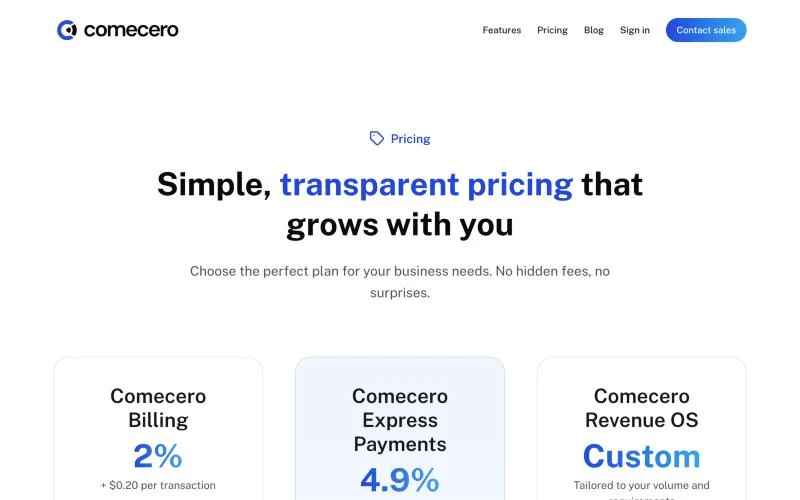
Comecero offers both directions on one platform. Comecero Billing is 2% + $0.20 per transaction and runs billing, checkout and commerce on top of the merchant account you already have. It covers subscriptions, free trials, usage, credits, seats, invoices and one-time payments, with dunning built on customizable retry rules. Express Payments is 4.9% + $0.40 for a fully managed stack that handles taxes, compliance and fraud (see pricing).
Checkout supports 100+ currencies, 16 languages and 40+ payment methods, plus promotions, bundles and cross-sells, which Stripe Billing doesn't really try to do.
Drawback: Comecero Billing costs more per transaction than Stripe Billing's 0.7%, so it only makes sense if you need the checkout and commerce features. It's also a smaller ecosystem than Stripe's. If you're unsure how much your current Stripe setup loses to failed renewals, run the free leakage detector first.
Chargebee: best for seats plus usage subscriptions

Chargebee is a subscription billing system that sits on top of a gateway like Stripe. Its pricing page lists usage-based billing on the Flow and Enterprise plans, with 100M usage events a month included on Flow. The Flow price scales with your billing volume, so check the slider for your number.
It's a good fit for B2B SaaS mixing seat plans with overages. It isn't a merchant of record, so tax and seller obligations stay with you.
Recurly: best for subscription businesses focused on retention
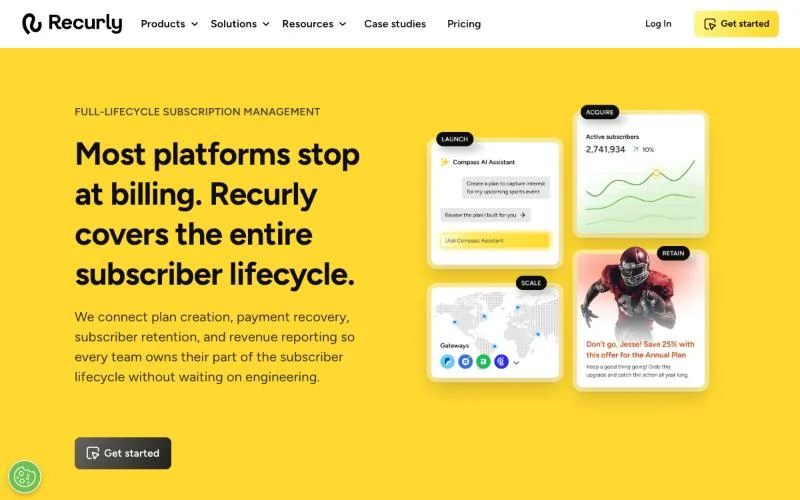
Recurly's pitch is the whole subscriber lifecycle: plans, payment recovery, retention offers and revenue reporting. Its pricing page lists the Starter plan at $249 a month plus 0.9% of billing volume, with the first $40K of billings each month free of the percentage fee. All-Access is under 1% with a $1M billing volume minimum.
The math has a narrow sweet spot. A SaaS billing $20K a month pays $249 on Recurly Starter and $140 on Stripe Billing. Recurly only comes out cheaper between roughly $36K and $55K a month (at $40K it's $249 against Stripe's $280), and above that the 0.9% overtakes Stripe's 0.7% again. So for most teams Recurly is a features decision, not a savings one.
Maxio: best for B2B finance teams

Maxio combines billing with revenue recognition and financial reporting. The Grow plan is $599 a month for up to $100K in monthly billings, with usage-based billing on all plans (Maxio pricing).
That's steep for a young company. For a CFO who currently exports Stripe data into spreadsheets every month-end, the reporting is the reason to switch.
Replace the tax and seller burden: merchants of record
A merchant of record becomes the legal seller of your product, so it collects and remits sales tax and VAT and handles chargebacks. You stop registering in each country. The trade-off is a higher all-in rate and less control over checkout. For a longer comparison, see our list of the best merchant of record providers. Comecero Express (above) also belongs in this group.
Paddle: best for scaling B2B SaaS
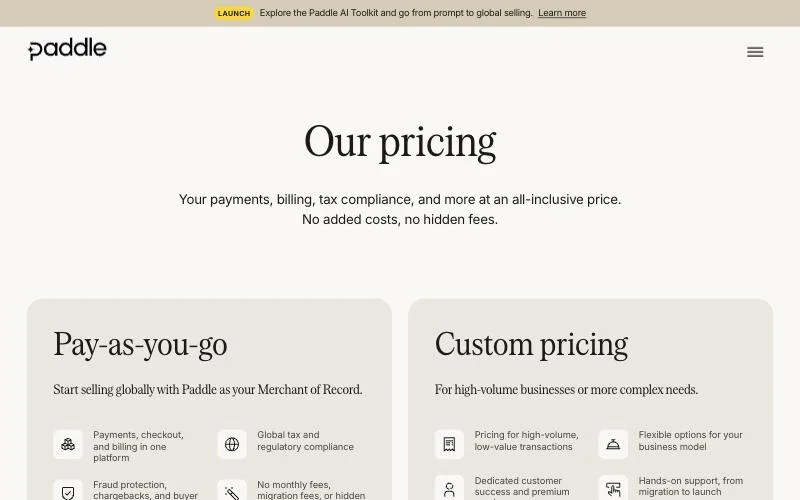
Paddle charges 5% + 50¢ per checkout transaction with no monthly fees, per Paddle's pricing page. Against Stripe's stacked 7.2% on a foreign-card, foreign-currency subscription (from our fees guide), Paddle's flat rate often comes out cheaper for international customers and more expensive for domestic ones.
It's selective about the businesses it approves, and native usage billing is still in early access according to Paddle's docs. More options in our Paddle alternatives guide.
FastSpring: best for established software sellers

FastSpring is a long-running MoR for software and SaaS. Pricing isn't published: its pricing page says fees vary with transaction volume and custom rates are negotiated with sales.
That's workable for a company with steady volume and the patience for a sales process. If you want to model costs before talking to anyone, it's frustrating.
Lemon Squeezy: best for the simplest possible start

Lemon Squeezy is 5% + 50¢ per transaction (pricing) and is one of the quickest MoRs to set up. The catch for anyone leaving Stripe: Stripe owns it, and its pricing page now carries a "2026 Update: Lemon Squeezy + Stripe Managed Payments" banner. If your goal is reducing dependence on Stripe, this doesn't do that. Our Paddle vs. Lemon Squeezy comparison covers the trade-off.
Polar: best developer-first MoR

Polar is an open-source MoR with usage meters and a clean API. Polar's pricing runs from a free Starter plan at 5% + 50¢ to Scale at $400 a month plus 3.4% + 30¢. International cards add 1.5%, and disputes cost $15 each.
At higher volume the paid plans can undercut Paddle, but it's young, and B2B invoicing is thinner than at the older MoRs.
Also an option: stay on Stripe with Managed Payments
If you like Stripe and only want the tax obligation gone, Stripe Managed Payments makes Stripe the merchant of record for an extra 3.5% per successful transaction on top of payments fees, for digital products in supported markets (Stripe Managed Payments). On a $50 domestic charge that's $3.50 in total ($1.75 processing plus $1.75), or 7%, which is more than Paddle's $3.00. Worth comparing before assuming staying put is cheapest.
Replace the processor
Changing processors makes sense when your payment volume is large enough for interchange-plus pricing to matter, or when you need a specific payment method mix. Both options below still need a billing layer and, for international sellers, a tax solution.

Adyen: best for high-volume global businesses

Adyen prices cards as a fixed processing fee plus the payment method fee. For Visa and Mastercard, its pricing page lists $0.13 + Interchange++ + 0.60%, with no setup or monthly fees, and calls those fees indicative. Interchange-plus pricing passes through the card networks' actual costs instead of a blended rate, so your bill tracks your real card mix.
It's built for enterprises. A seed-stage SaaS will find the onboarding and integration heavier than Stripe's.
Braintree (PayPal Enterprise Payments): best if you want PayPal in the same stack
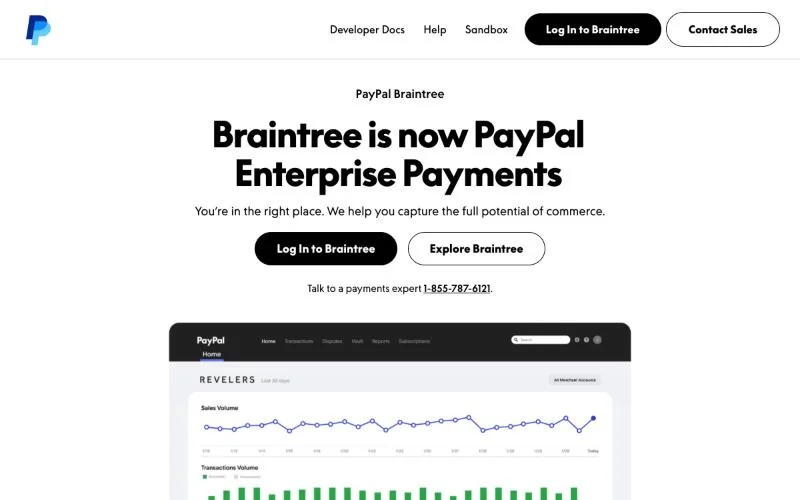
Braintree is PayPal's developer-focused processor, and its site now says "Braintree is now PayPal Enterprise Payments." Braintree's pricing lists 2.59% + $0.49 for cards and digital wallets, an extra 1% for charges presented in a non-USD currency, and a $15 chargeback fee.
The percentage is lower than Stripe's, but the 49¢ fixed fee is higher, so it only wins on larger charges. On a $50 charge Braintree costs $1.79 against Stripe's $1.75.
Migrating off Stripe without losing subscribers
The hard part of leaving Stripe is the stored cards behind your active subscriptions. Before you choose a destination, ask both your new provider and Stripe how card data and subscription schedules move over, and whether customers will need to re-enter payment details. Plan the cutover around renewal dates, run old and new systems in parallel for at least one billing cycle, and keep your Stripe account open until disputes on old charges are resolved (disputes can arrive months later).
If you're moving to a merchant of record, also check what happens to tax registrations you already hold. You may still need to file final returns for periods when you were the seller.
Which Stripe alternative fits?
A US-focused SaaS that likes Stripe payments but has outgrown Stripe Billing should look at Chargebee, Recurly or Maxio, or Comecero Billing if checkout and commerce features matter.
A SaaS selling into Europe, the UK and Asia that's tired of VAT registrations should price a merchant of record: Paddle or FastSpring at scale, Polar or Lemon Squeezy early on, or Comecero Express.
An AI or API product with usage pricing should check metering support before anything else. Our usage-based billing software roundup covers that.
A company processing many millions a year should get an Adyen quote and ask Stripe for custom pricing at the same time. The competition alone usually moves the number.
Frequently Asked Questions
Everything else you might be wondering about.
The bottom line
Name the problem before picking the tool. Billing limits, tax burden and processor cost each have a different fix, and most teams only need one of them. Run your last three months of transactions through the fee math in our Stripe fees guide, then compare the two options that fit your problem. If you'd like to see your numbers on Comecero with or without Stripe underneath, check pricing or talk to the team.