
Usage-Based Billing Software: 10 Best Tools for SaaS and AI (2026)

The best usage-based billing software for SaaS and AI in 2026: metering engines, billing platforms and merchants of record compared on pricing, tax and fit.
Usage-Based Billing Software: 10 Best Tools for SaaS and AI (2026)
Updated October 2026. Pricing checked on each vendor's own site.
TL;DR:
Metering and rating engines
- Orb: usage pricing for API and AI products, priced at roughly 0.6% of billing volume.
- Metronome: enterprise usage billing and contracts, now part of Stripe.
- Lago: open-source metering you can self-host.
Billing platforms with usage
- Stripe Billing: 0.7% of billing volume, with Meters for basic usage pricing.
- Chargebee: hybrid seats plus usage on its Flow and Enterprise plans.
- Maxio: B2B SaaS finance teams, from $599/month.
Merchants of record and managed stacks with usage
- Paddle: native usage billing in early access, on top of its MoR.
- Dodo Payments: MoR built around metered and credit pricing.
- Polar: open-source MoR with meters billed on the next invoice.
- Comecero: usage, credits and seats on your own processor or fully managed.
If you only need to meter usage and generate invoices on top of Stripe, Orb, Metronome or Lago will do it. If you want one billing system for seats, usage and invoices, look at Chargebee, Maxio or Stripe Billing. The question that splits the list is tax. None of the first six collects and remits sales tax or VAT as the seller, so if you sell to customers in thirty countries and don't want thirty registrations, you need a merchant of record with usage support.
Usage pricing is common in AI products, where one customer burns 40 million tokens in a week and the next one burns 200. Billing that well is mostly a data problem (count the events, apply the price, show the customer what they owe) with a tax and payments problem sitting on top. The tools below solve different slices of it. If you're still deciding whether an MoR belongs in your stack at all, start with merchant of record for AI companies.
What usage-based billing software actually does
There are five jobs, and most tools only do some of them. Metering collects usage events (API calls, tokens, GPU seconds). Rating turns those events into money using your price model. Invoicing puts the charges on a bill. Collection charges the card or chases the invoice. Tax adds the right sales tax or VAT and files it.
Metering engines are strongest at the first two. Billing platforms cover rating through collection. A merchant of record covers collection and tax, and the ones on this list also handle metering (Paddle's is still in beta). That's the main reason to compare across categories instead of picking the most popular metering tool.

How we compared them
We looked at how each tool meters usage, which price models it supports (per-unit, tiered, prepaid credits, seats plus overage), whether customers can see their usage before the invoice arrives, whether it handles tax or acts as merchant of record, and how much engineering it takes to set up. Prices come from vendor pricing pages in October 2026. Comecero is our product and is included with a drawback like the others.
Usage-based billing software compared at a glance
| Tool | Type | Pricing (Oct 2026) | Handles sales tax/VAT? | Acts as MoR? | Best for |
|---|---|---|---|---|---|
| Orb | Metering & rating | $6 per credit (≈0.6% of billing volume); Enterprise custom | Via Avalara, Anrok or Stripe Tax | No | API and AI products at volume |
| Metronome | Metering & rating | Starter: % of billed volume + per-1K events; Custom | Not as seller | No | Enterprise contracts |
| Lago | Metering & rating | Open source; Premium by quote | Not as seller | No | Self-hosting teams |
| Stripe Billing | Billing platform | 0.7% of billing volume | Stripe Tax sold separately | No | Teams already on Stripe |
| Chargebee | Billing platform | Usage on Flow and Enterprise plans | Via integrations | No | Hybrid seats + usage |
| Maxio | Billing platform | Grow $599/month (up to $100k billings) | Via integrations | No | B2B SaaS finance |
| Paddle | MoR | 5% + 50¢ | Yes | Yes | Scaling SaaS (usage in beta) |
| Dodo Payments | MoR | 4% + 40¢ + 0.5% usage add-on | Yes | Yes | Credit and token pricing |
| Polar | MoR | 5% + 50¢ free; paid plans from $20/month | Yes | Yes | Developer-first indie SaaS |
| Comecero | Billing + MoR | 2% + $0.20 (own processor) or 4.9% + $0.40 | Yes, on managed plan | See plan details | Usage plus checkout in one place |
The 10 best usage-based billing tools
Orb
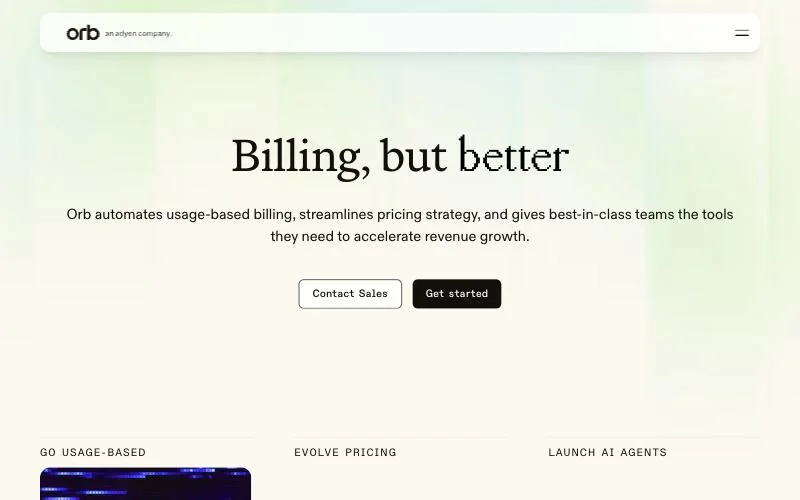
Orb is built for companies whose price list is basically a spreadsheet of usage dimensions. Its homepage says it "automates usage-based billing" and "streamlines pricing strategy": it ingests events, prices them and generates invoices. The same page brands it "an Adyen company," so Orb, like Metronome, sits inside a large payments business.
Its Business plan is priced in credits at "$6.00" each, and Orb's FAQ says one credit works out to 0.60% of billing volume (Orb pricing). Enterprise is custom. Tax comes through "your tax provider of choice," with Avalara, Anrok and Stripe Tax listed.
Downside: Orb is a billing layer, not a seller. You still need a processor, a tax tool and your own registrations, which is a lot of moving parts for a five-person AI startup.
Metronome
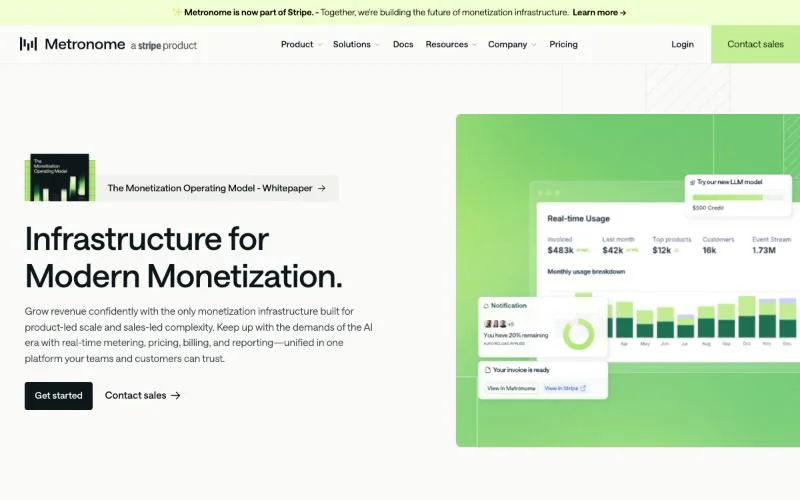
Metronome pitches "real-time metering, pricing, billing, and reporting" for companies with product-led scale and sales-led complexity, which in practice means large, contract-heavy usage customers. Its site now says "Metronome is now part of Stripe," and Stripe's billing pricing page routes advanced usage billing through Metronome.
Metronome's pricing page lists a Starter tier that charges a percentage of billed volume plus a fee per thousand events, and a Custom tier through sales. It's excellent if your customers sign six-figure annual commits. It's overkill if they pay $49 a month.
Lago
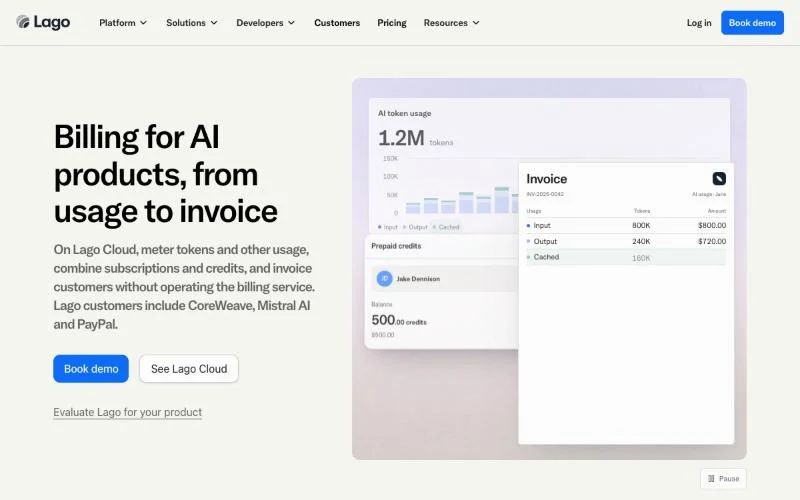
Lago is the open-source option. You can deploy it from GitHub and run metering on your own infrastructure, or use Lago Cloud. Lago's pricing page doesn't publish prices for its Premium tier, so you'll be talking to sales for anything beyond the open-source core.
Self-hosting is the selling point and also the cost: someone on your team now owns a billing system's uptime. For teams with strict data-residency needs, that's a fair trade.
Stripe Billing
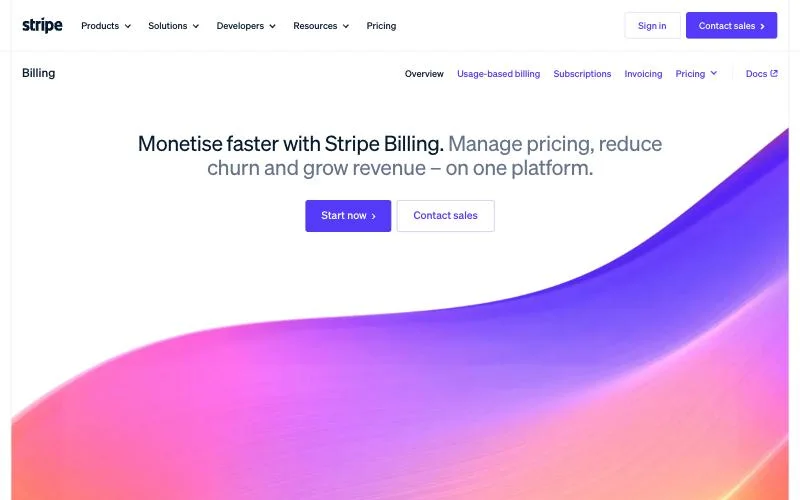
If you already process payments on Stripe, Billing is the shortest path. Pay-as-you-go pricing is 0.7% of billing volume, and Stripe says "Basic usage-based billing features will continue to be available via Stripe's Meters API as part of Billing pricing, with up to 100M events per month included" (Stripe Billing pricing).
The catch is that tax is a separate product (Stripe Tax), and you remain the seller everywhere you have customers. Billing calculates, but the VAT registrations are yours. Stripe also sells its own MoR, Stripe Managed Payments, if you'd rather hand that off.
Chargebee
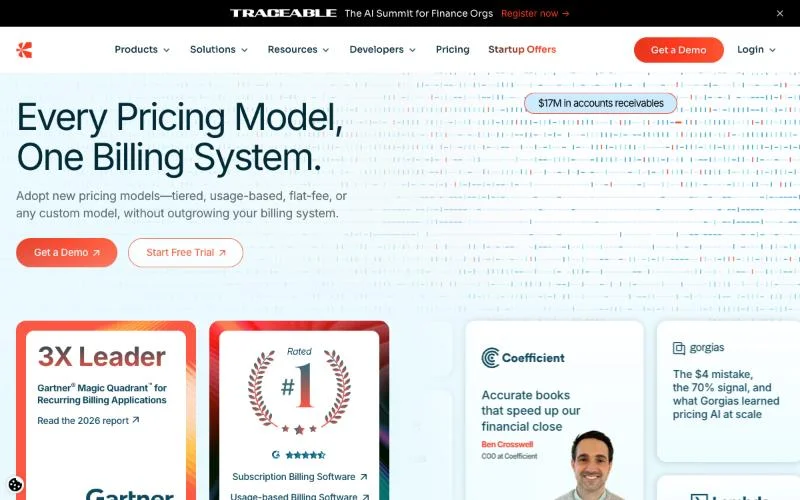
Chargebee suits companies mixing seat-based plans with usage overages, which describes a lot of B2B SaaS right now. Its pricing page marks usage-based billing as included on the Flow and Enterprise plans, and Flow includes 100M usage events a month. Check the page for the current Flow rate, which scales with your billing volume.
It's a mature billing system. It isn't a merchant of record, so tax and seller liability stay with you. We cover where Chargebee fits against MoRs in Paddle alternatives.
Maxio

Maxio is aimed at finance teams: revenue recognition, SaaS metrics and invoicing for B2B. Usage-based billing is listed under "All plans include," and the Grow plan is "$599 / month" for up to $100k in monthly billings, with Scale priced by quote (Maxio pricing).
For an early-stage product, $599 a month before you bill anything is steep. For a CFO closing the books on $3M ARR, the reporting may be worth more than the metering.

Paddle
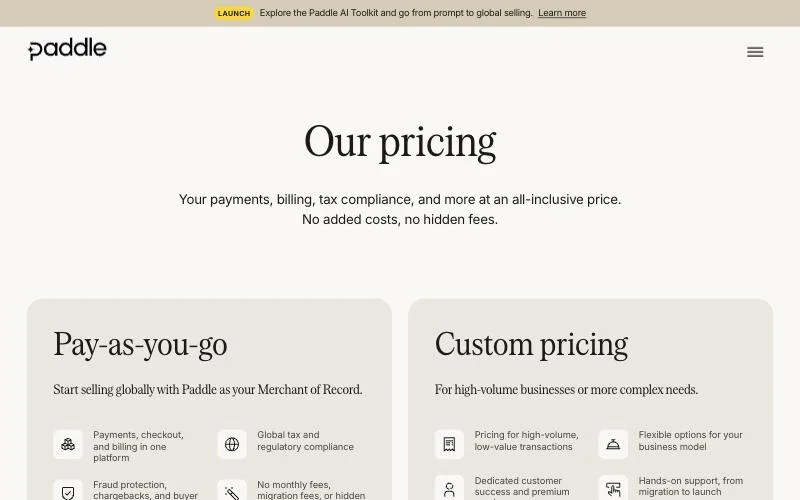
Paddle is a full merchant of record at 5% + 50¢ per transaction (Paddle pricing), so it handles tax and acts as seller. Native usage-based billing exists, but it's in early access: Paddle's developer docs describe usage balances, meters and allowances, behind a beta application.
That makes Paddle a good fit if usage is one part of your pricing (say, an AI add-on on top of seats) and you can wait for beta access. If usage is your whole business model today, test the beta before you commit.
Dodo Payments
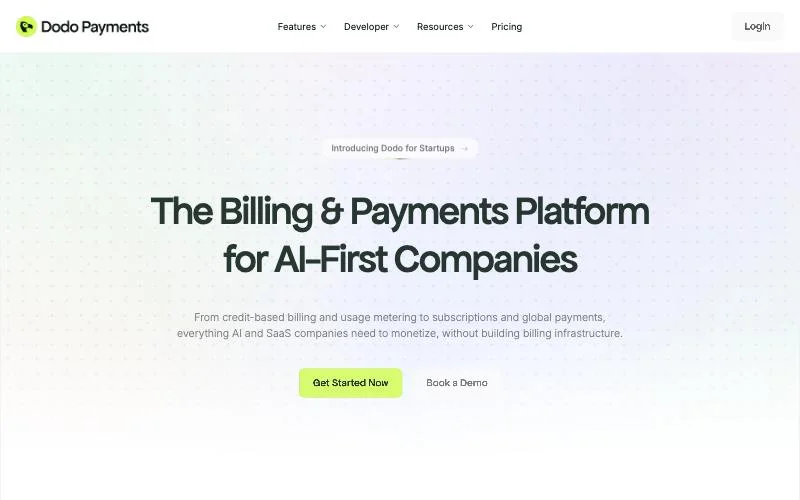
Dodo Payments is an MoR that leads with metered billing "for usage-based model like token usage, customer credits." Per Dodo's pricing page, the base rate is 4% + 40¢ for domestic US cards, with 0.5% added for subscriptions and usage-based billing and 1.5% for international payments.
It's one of the few MoRs where credits and token billing are the main pitch rather than an afterthought. The add-ons add up, though. A usage charge on a non-US card lands at 6% + 40¢, so model your customer mix first.
Polar
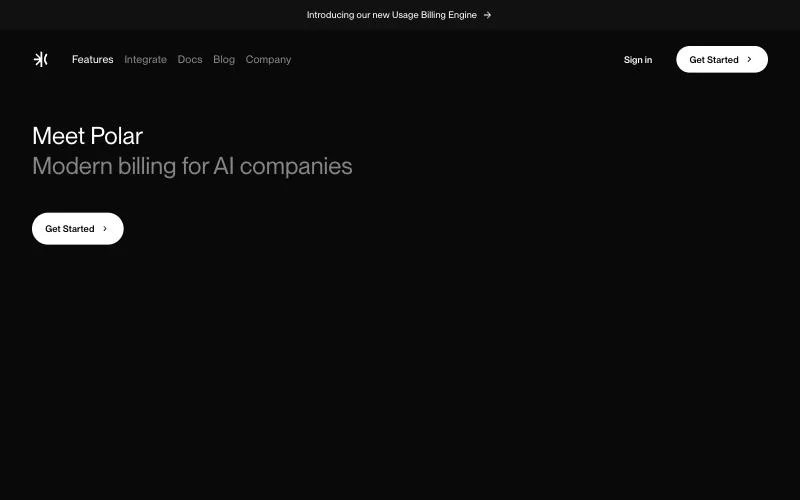
Polar is an open-source MoR with meters that aggregate events per customer. Attach a meter to a product and "Polar reads the meter at the end of each cycle" and bills the usage on the next invoice (Polar usage billing). Plans run from a free Starter tier at 5% + 50¢ to Scale at $400/month plus 3.4% + 30¢ (Polar pricing).
It's very developer-friendly. B2B invoicing and enterprise contract features are thinner than at Paddle or Maxio, and international cards add 1.5%.
Comecero
Comecero combines billing, checkout and merchant-of-record services. Its Premium Billing covers usage, credits, seats, subscriptions, invoices and one-time payments, with dunning that uses customizable retry rules and grace periods.
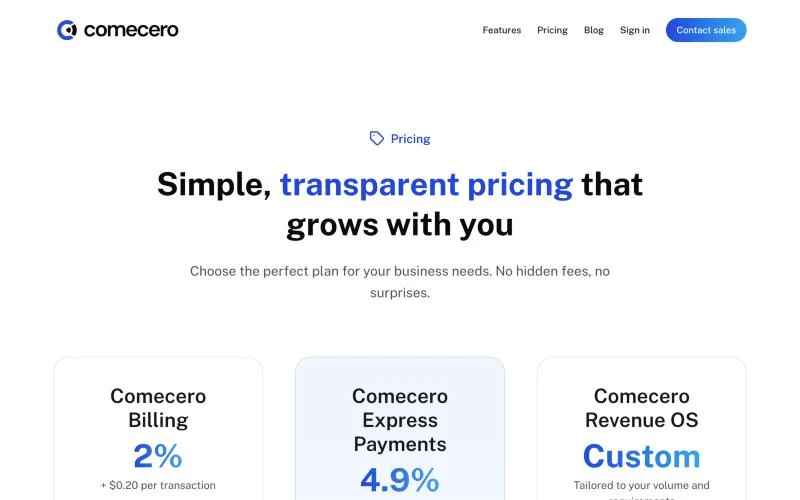
The pricing choice is the interesting part. Comecero Billing is 2% + $0.20 per transaction on top of a processor you already have, while Express Payments is 4.9% + $0.40 for a fully managed stack that handles taxes, compliance and fraud (see pricing). So you can keep Stripe, for example, and still get usage billing plus checkout from one place, or hand off payments entirely.
Drawback: Comecero's metering is less specialized than dedicated engines like Orb or Metronome. If your pricing has dozens of usage dimensions and custom enterprise rate cards, a metering engine will model it more finely. Comecero makes more sense when you want usage billing, checkout and tax handled together.
Which type do you need?
An early-stage AI app selling prepaid credits to consumers around the world wants an MoR with credit support (Dodo, Polar or Comecero), because tax registrations would cost more engineering and accounting time than the billing itself. Don't buy a metering engine at this stage.
An API company already processing on Stripe, billing per call to mostly US customers, can start with Stripe Billing's Meters and add Stripe Tax. Move to Orb or Metronome when pricing experiments start needing their own tooling.
B2B SaaS with seats plus overages, selling annual contracts, fits Chargebee or Maxio. Add an MoR only if international tax becomes painful.
Selling globally without wanting to register for VAT or GST anywhere narrows the list to the MoRs: Paddle (if the beta works for you), Dodo, Polar or Comecero Express.
Pricing models you can run on these tools
Per-unit pricing charges a flat rate per event, like $0.002 per 1,000 tokens. Tiered or volume pricing lowers the rate as usage grows, for example $0.10 per call up to 100,000 calls and $0.06 after that. Prepaid credits let customers buy a balance (1,000 credits for $50) that drains as they use the product, which protects your cash flow. Hybrid models charge a seat fee plus overage above an included allowance. And minimum commit plus overage, where an enterprise customer pays $5,000 a month for a committed volume and a per-unit rate above it, is what Metronome and Orb were largely built for.
These numbers are illustrations. The point is to check which of these models a tool supports natively before you design pricing around one it can only fake.
Common mistakes when moving to usage-based billing
Surprise invoices are the big one. If customers can't see usage climbing during the month, the first $4,000 bill turns into a support ticket and then a chargeback. Pick a tool with customer-facing usage views, or build them.
Large usage charges can also fail for reasons a small renewal rarely hits: the card reaches its limit, or the bank flags an amount that's ten times last month's. Dunning and retry rules matter more under usage pricing, not less. If you're on Stripe, our free revenue leakage detector shows how much failed-payment revenue your current setup isn't recovering.
And usage charges are usually taxable wherever the subscription is. Teams sometimes set up tax for the base plan and forget the overage line. Our guide to SaaS VAT and sales tax covers the basics.
Frequently Asked Questions
Everything else you might be wondering about.
The bottom line
Decide the tax question before you compare features. If you'll stay the seller, pick the metering or billing tool that matches how complex your pricing is (Stripe Billing for simple, Orb or Metronome for complex). If you won't, shortlist the MoRs and test their usage features with a real month of your event data. To see how usage, credits and seats would run on Comecero with or without your current processor, check pricing or talk to the team.