
Stripe Fees Explained (2026): What Stripe Really Costs a SaaS Business


Stripe fees in 2026: 2.9% + 30¢ per card charge, plus international, currency, Billing and Tax fees. See the real all-in cost for a SaaS business.
Stripe Fees Explained (2026): What Stripe Really Costs a SaaS Business
Updated October 2026. All figures from Stripe's US pricing page.
TL;DR:
| Fee | Stripe US standard rate |
|---|---|
| Domestic cards and wallets | 2.9% + 30¢ per successful charge |
| International cards | +1.5% |
| Currency conversion | +1% |
| Manually entered cards | +0.5% |
| ACH Direct Debit | 0.8%, capped at $5.00 |
| Disputes (chargebacks) | $15 per dispute received, plus $15 if you counter it (refunded if you win) |
| Stripe Billing | 0.7% of Billing volume (pay as you go) |
| Stripe Tax Basic | 0.5% per transaction where you're registered (no-code) |
Stripe's headline fee is 2.9% + 30¢ per successful US card charge. A SaaS business running subscriptions on Stripe Billing with Stripe Tax usually pays closer to 4.7% on a $50 domestic charge, and around 7% when the customer pays with a foreign card in another currency. The gap comes from add-ons that each look small on their own.
That stacking is what a Reddit thread on r/stripe calls "fees on fees on fees." Below is every fee a subscription business typically hits, three worked examples with real totals, and the levers that bring the number down.
Stripe's standard payment fees
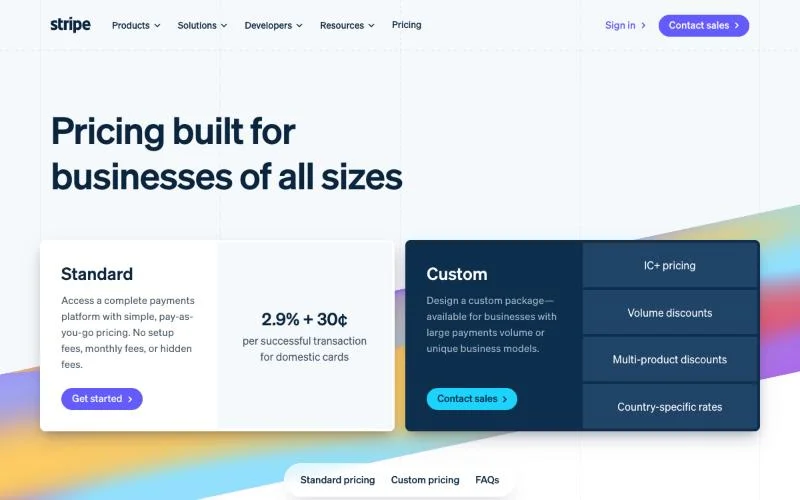
Stripe's pay-as-you-go pricing has no setup or monthly fees. You pay per successful charge, and the base card rate is 2.9% + 30¢ for domestic cards and digital wallets like Apple Pay and Google Pay.
Then the modifiers start. A card issued outside the US adds 1.5%. If the charge currency differs from your payout currency, add another 1%. A card your team types in manually (phone orders, for example) adds 0.5%. Klarna runs 5.99% + 30¢. ACH Direct Debit is much cheaper at 0.8% with a $5.00 cap, which matters a lot for large B2B invoices.
Disputes have their own line. Stripe charges a $15 "dispute received" fee on every chargeback, and another $15 "dispute countered" fee if you respond manually. You get the countered fee back when you win, but not the received fee. Stripe also sells Smart Disputes, which charges 30% of the disputed amount on disputes it wins for you.
Large companies can ask for custom pricing. Stripe lists IC+ (interchange-plus) pricing, volume discounts and multi-product discounts for businesses with large payment volume.

The SaaS add-ons: Billing, Tax, Invoicing and Radar
Card processing is only part of the bill for a subscription company.
Stripe Billing runs subscriptions, invoices and Smart Retries for failed payments. Pay-as-you-go pricing is 0.7% of Billing volume, and it applies to Billing transactions processed on and off Stripe. Annual plans start at $620 a month on a one-year contract if you'd rather pay a flat fee at higher volume.
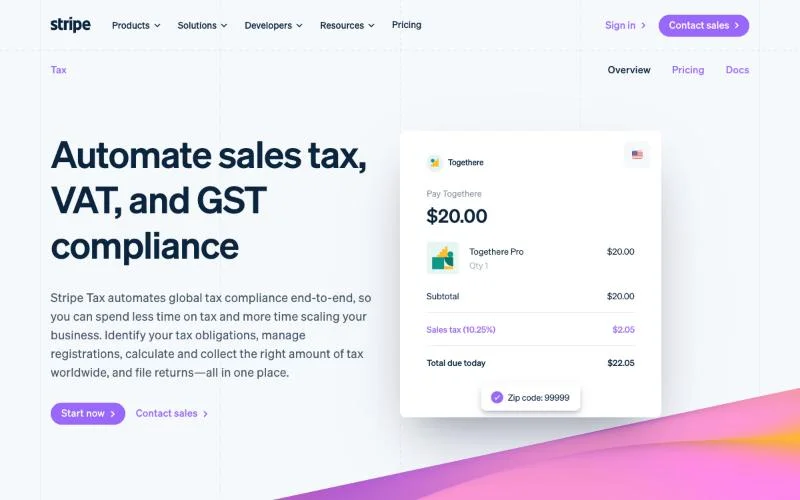
Stripe Tax calculates and collects sales tax, VAT and GST. Tax Basic costs 0.5% per transaction where you're registered to collect tax if you use no-code integrations (Billing, Checkout, Invoicing, Payment Links), or $0.50 per transaction through the API. Tax Complete, which adds threshold monitoring, registrations and filings, starts at $90 a month on a one-year contract (Stripe Tax).
One thing Stripe Tax doesn't change: you're still the seller. You register for VAT in the EU and UK, sales tax in each US state where you have nexus, and you're liable if a filing is wrong. Stripe Tax automates the calculation and, on Complete, the registrations and filings. The legal obligation stays yours.
Invoicing costs 0.4% per paid invoice on the Starter plan, and post-payment invoices on Checkout are 0.4% capped at $2.00. Radar Lite fraud screening is included with Payments. The full Radar product starts at $0.05 per screened transaction or $10 a month.
And if you don't want the tax obligation at all, Stripe Managed Payments makes Stripe the merchant of record for an extra 3.5% per successful transaction on top of payments fees.
Three worked examples
Fees per charge are hard to feel. Totals are easier. Each example below assumes Stripe Billing on pay-as-you-go and Stripe Tax Basic (no-code), and that you're registered to collect tax for the customer.
A $50/month subscription, US customer, US card
| Line | Cost |
|---|---|
| Card processing (2.9% + 30¢) | $1.75 |
| Billing (0.7%) | $0.35 |
| Tax Basic (0.5%) | $0.25 |
| Total | $2.35 (4.7%) |
The 30¢ fixed fee is 0.6 points of that on its own. On a $9/month plan the same stack is $0.67, or 7.4%.
The same $50 subscription, EU customer paying in euros
| Line | Cost |
|---|---|
| Card processing (2.9% + 30¢) | $1.75 |
| International card (+1.5%) | $0.75 |
| Currency conversion (+1%) | $0.50 |
| Billing (0.7%) | $0.35 |
| Tax Basic (0.5%) | $0.25 |
| Total | $3.60 (7.2%) |
That's before the cost of being registered for EU VAT (typically through the One-Stop Shop) and filing quarterly returns, which Stripe Tax Basic doesn't do for you.
A SaaS doing $20,000 a month
Say 400 subscribers at $50, 60% in the US and 40% abroad paying in their own currency, plus two chargebacks a month that you don't contest.
US charges: 240 × $2.35 = $564. International charges: 160 × $3.60 = $576. Disputes: 2 × $15 = $30. Total: $1,170 a month, or 5.85% of revenue, plus whatever you spend on tax registrations and filings in the countries where you sell.

Fees people miss
The fixed 30¢ is the one that hurts cheap plans. Every charge pays it, so a $5 plan loses 6 points to the fixed fee alone before any percentage.
Currency conversion is the sneaky one. It applies whenever the charge currency differs from the currency you're paid out in, so pricing in euros but settling in dollars triggers it on every European charge.
Disputes cost money even when you win: the $15 received fee isn't refunded. Two chargebacks a month on the example above is $360 a year in fees alone.
And failed renewals cost more than any fee on this page. A subscription that fails to renew and never recovers is 100% of that revenue lost. If you're on Stripe, our free revenue leakage detector connects with a read-only key and shows which failed payments turned into lost revenue and how much your current retry setup already recovers.
How to lower your Stripe fees
Ask for custom pricing once volume justifies it. Stripe offers IC+ pricing and volume discounts through sales, and interchange-plus can beat 2.9% when a lot of your volume runs on lower-cost domestic debit cards.
Bill annually where you can. A $600 annual charge costs $17.70 in card fees, against $21.00 for twelve $50 monthly charges, because you pay the 30¢ once instead of twelve times. Bigger gap on cheaper plans.
Push large B2B invoices to ACH. At 0.8% with a $5 cap, a $10,000 invoice costs $5 by ACH and $290.30 by card.
Think about currency deliberately. Presenting prices in the customer's currency can raise conversion, but it triggers the 1% conversion fee if you settle in USD. Holding balances or settling in that currency (where Stripe supports it) removes that 1%.
Stripe vs. a merchant of record on cost
This is where the honest answer depends on your customer base.
For a mostly US SaaS, Stripe is usually cheaper. The $50 domestic example costs 4.7% all-in, and you only need sales tax registrations in the states where you have nexus.
For a mostly international SaaS, the numbers get close. Comecero Express Payments is listed at 4.9% + $0.40 per transaction, which on a $50 charge is $2.85 (5.7%), and Comecero handles taxes, compliance and fraud on that plan (see pricing). Ask any MoR, Comecero included, how cross-border cards and currency conversion are priced before you compare. Paddle's pay-as-you-go rate is 5% + 50¢, or $3.00 (6%). Stripe's own MoR option, Managed Payments, adds 3.5% to the processing fee. Against Stripe's 7.2% for an EU customer, an MoR can come out level or cheaper once you count the VAT registrations and filings you no longer handle.
If you'd rather keep Stripe for payments and only change the billing and checkout layer, Comecero Billing runs on top of your existing processor at 2% + $0.20 per transaction. That's more than Stripe Billing's 0.7%, so it's a choice about checkout, commerce and multi-processor features, not a way to save on fees. For the full range of options, see our guides to Stripe alternatives for SaaS and the best merchant of record providers.
Frequently Asked Questions
Everything else you might be wondering about.
The bottom line
Work out your real Stripe rate with your own mix: base card fee, international and currency share, Billing, Tax and disputes. If it lands above 5–6% and a big share of customers are outside the US, price out a merchant of record alongside it. If it's under 5% and you're mostly domestic, Stripe is probably the right call, and the bigger win is recovering failed renewals. Questions about your numbers? Talk to the Comecero team.