
Best Merchant of Record Providers (2026): 10 MoR Services Compared


Compare the best merchant of record providers for 2026 (Paddle, Lemon Squeezy, FastSpring, Comecero and more) on fees, liability, billing depth and fit.
Best Merchant of Record Providers (2026): 10 MoR Services Compared
Updated October 2026. Fees checked against each provider's own pricing page unless noted.
TL;DR:
- Paddle: the default pick for scaling B2B SaaS, at 5% + 50¢ with no monthly fee.
- FastSpring: long-running MoR for software publishers; pricing is quote-based.
- Lemon Squeezy: easiest start for indie products, now part of Stripe.
- Comecero: keep your own processor (2% + $0.20) or go fully managed (4.9% + $0.40).
- PayPro Global: all-features-included MoR for software, priced by quote.
- Cleverbridge: enterprise and complex B2B subscription commerce.
- 2Checkout (Verifone): tiered plans; reviews say global tax comes with the top tier.
- Polar: developer-first and open source, with plans from free to $400/month.
- Dodo Payments: newer MoR built around usage and metered pricing.
- Creem: lowest published flat rate here (3.9% + 40¢) for early AI and indie products.
Most scaling SaaS teams end up choosing between Paddle and FastSpring, and the deciding factor is usually whether you want published pricing (Paddle) or a negotiated contract (FastSpring). Indie founders tend to start on Lemon Squeezy, Polar or Creem because setup takes an afternoon. If you already have a processor you like and only want billing, tax and checkout handled on top of it, Comecero Billing is the unusual option on this list.
A merchant of record (MoR) is the company that legally sells your product to the customer, so it collects and remits sales tax and VAT and takes on chargebacks and payment compliance. Every provider below offers a plan built around that model. Liability terms differ in the fine print, so read each contract's chargeback and tax clauses before signing. Everything else, from price to billing depth to who they'll approve, varies a lot.
This list only covers true MoRs. Billing tools like Chargebee and Recurly don't belong here, because you stay the seller and keep the tax liability. If that distinction is new, our breakdown of merchant of record vs. payment service provider explains it.
How we compared them
We looked at five things: whether the provider really acts as the legal seller (tax remittance plus chargeback liability), how transparent its pricing is, how deep its billing goes (subscriptions, usage, invoicing for B2B), how much control you get over checkout, and what stage of company it actually suits. Fees come from each provider's pricing page in October 2026. One exception: 2Checkout's pricing page wouldn't load for us, so its rates come from published reviews and are marked as such.
Comecero is our product. We've placed it where its strengths fit, not at the top by default, and it gets a drawback like everyone else.
Merchant of record providers compared at a glance
| Provider | Pricing (Oct 2026) | Published rate? | Usage billing | Best for |
|---|---|---|---|---|
| Paddle | 5% + 50¢, no monthly fee | Yes | Early-access beta | Scaling B2B SaaS |
| FastSpring | Quote-based, varies with volume | No | Not advertised | Established software sellers |
| Lemon Squeezy | 5% + 50¢, extra fees on some non-US payments | Yes | Not advertised | Indie products |
| Comecero | 2% + $0.20 (own processor) or 4.9% + $0.40 (managed) | Yes | Usage, credits, seats | Keep-your-processor or fully managed |
| PayPro Global | Quote-based, all features included | No | Not advertised | Software with broad localization |
| Cleverbridge | Custom, transaction-based | No | Not advertised | Enterprise and complex B2B |
| 2Checkout | 3.5% + $0.35 to 6% + $0.60 by tier* | Per reviews* | Not advertised | Legacy global digital sales |
| Polar | 5% + 50¢ free plan; 3.4%–3.8% on paid plans | Yes | Yes (meters) | Developer-first indie SaaS |
| Dodo Payments | 4% + 40¢ US cards, plus add-ons | Yes | Yes | Usage-based pricing |
| Creem | 3.9% + 40¢, no monthly fee | Yes | Advertised | Early AI and indie products |
*2Checkout rates as reported by NerdWallet and TechRadar; confirm on 2Checkout's site before signing.

The 10 best merchant of record providers
1. Paddle: best for scaling B2B SaaS
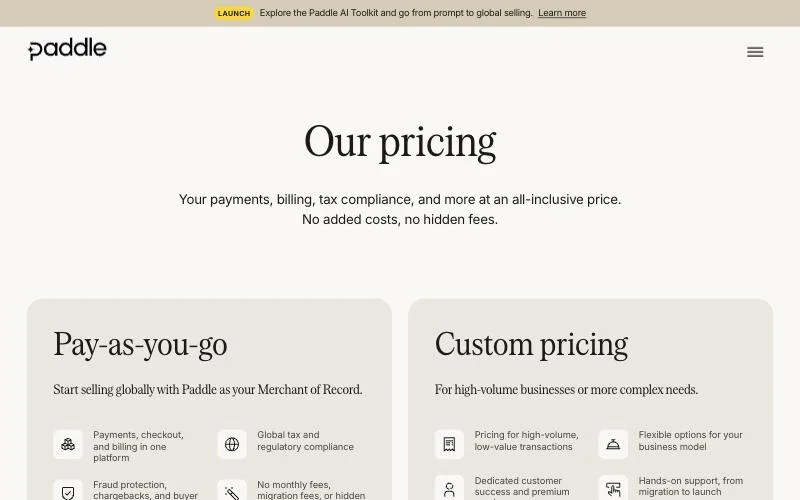
Paddle is the name most SaaS founders hear first, and for B2B software it's usually earned. You get an API-first checkout, subscription billing built for SaaS, and Retain (from the ProfitWell acquisition) for failed-payment recovery and churn analytics.
Pricing is simple. The pay-as-you-go plan is 5% + 50¢ per checkout transaction with "no monthly fees, migration fees, or hidden extras," per Paddle's pricing page. High-volume businesses and products under $10 can ask for custom pricing.
The downside: Paddle is selective about which business models it approves, and it standardizes a lot of the buying experience. Native usage-based billing is still in early access, according to Paddle's developer docs, so heavy metered pricing means applying for the beta or calculating charges yourself. Read our Paddle alternatives if that's a blocker.
2. FastSpring: best for established software and games publishers

FastSpring has been selling software as an MoR for well over a decade, and it shows in the store features, localized checkout and handling of one-time licenses alongside subscriptions.
It doesn't publish a rate. FastSpring's pricing page says fees "vary depending on the transaction volume" and that custom rates are negotiated with sales. That's fine if you have volume to negotiate with. It's annoying if you're trying to model costs before a sales call, and smaller sellers have less leverage.
Verdict: a safe, mature choice for publishers with steady volume. Compare it head to head in Paddle vs. FastSpring or browse FastSpring alternatives.
3. Lemon Squeezy: best for indie developers already on Stripe
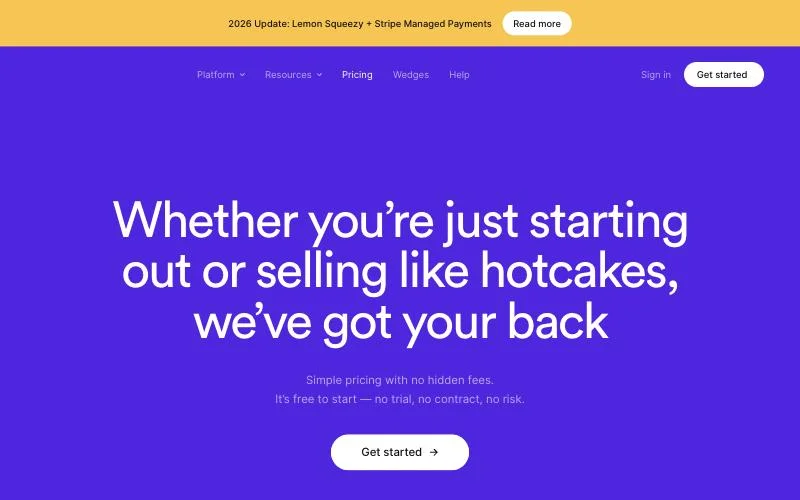
Lemon Squeezy made MoR coverage approachable. Sign up, create a product, share a checkout link, and taxes are handled. It covers subscriptions, license keys and a basic storefront.
Lemon Squeezy's pricing page lists 5% + 50¢ per transaction and notes that transactions outside the US "may encounter small additional fees." Stripe acquired Lemon Squeezy in 2024, and the pricing page now carries a "2026 Update: Lemon Squeezy + Stripe Managed Payments" banner.
That banner is the drawback. Lemon Squeezy's roadmap now sits inside Stripe's own MoR strategy, so teams planning five years out should watch what happens before committing. For the full picture, see Lemon Squeezy alternatives and Paddle vs. Lemon Squeezy.
4. Comecero: best for teams that want to keep their own processor, or go fully managed
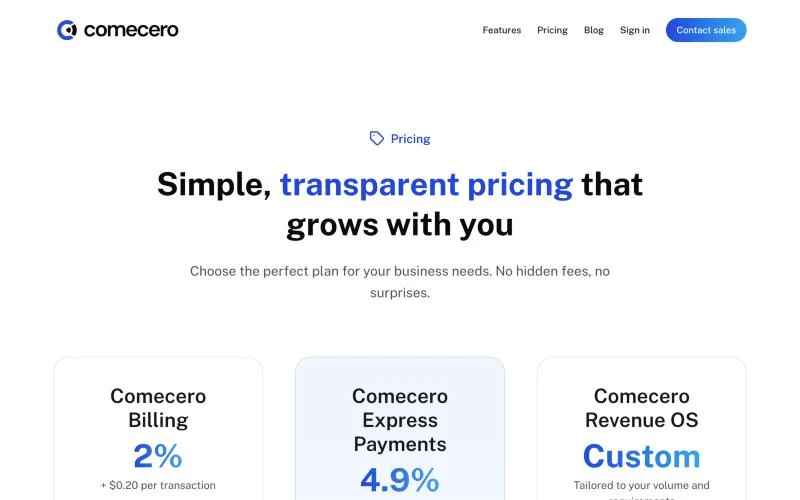
Comecero is a payments, billing and MoR platform for SaaS, software, digital goods and e-commerce sellers. It sells two clearly different models at published prices, which few providers here do (Dodo also lists a bring-your-own-processor add-on).
Comecero Billing is 2% + $0.20 per transaction and runs billing, checkout and commerce on top of the merchant account you already have. Express Payments is 4.9% + $0.40 per transaction for a fully managed stack that handles taxes, compliance and fraud. Larger companies can get a custom Revenue OS plan with authorization optimization and decline recovery. There are no setup fees, and monthly plans cancel anytime (see pricing).
Billing covers subscriptions, free trials, usage, credits, seats, invoices and one-time payments. Checkout runs in 100+ currencies and 16 languages with 40+ payment methods. If you're on Stripe today, our free revenue leakage detector shows how many failed renewals your current retry setup never recovers.
Drawback: Comecero is a smaller brand with a smaller ecosystem than Paddle or FastSpring, so expect fewer third-party tutorials and integrations, and Revenue OS pricing is quote-based.
5. PayPro Global: best for software sellers needing broad localization

PayPro Global is a software-focused MoR that bundles everything into one plan: global payments, billing, fraud protection, analytics and MoR services. Its pricing page says "One fair price, all features included" but publishes no number, so you'll need a quote.
It's a reasonable FastSpring alternative for desktop and SaaS publishers who sell into many countries. The downside matches FastSpring's. With no public rate, comparing it on cost means sitting through a sales process first.
6. Cleverbridge: best for enterprise and complex B2B

Cleverbridge targets larger software companies with complex subscription and B2B requirements. Its pricing page offers custom, transaction-based pricing that depends on sales volume, payment mix, currencies and customer locations.
If you're a mid-market or enterprise vendor with a finance team that wants negotiated terms, that's a feature. If you're doing $15k a month, you're probably not who they're built for. Our Cleverbridge vs. FastSpring comparison covers the trade-offs in more detail.
7. 2Checkout (Verifone): best for wide international coverage on older stacks
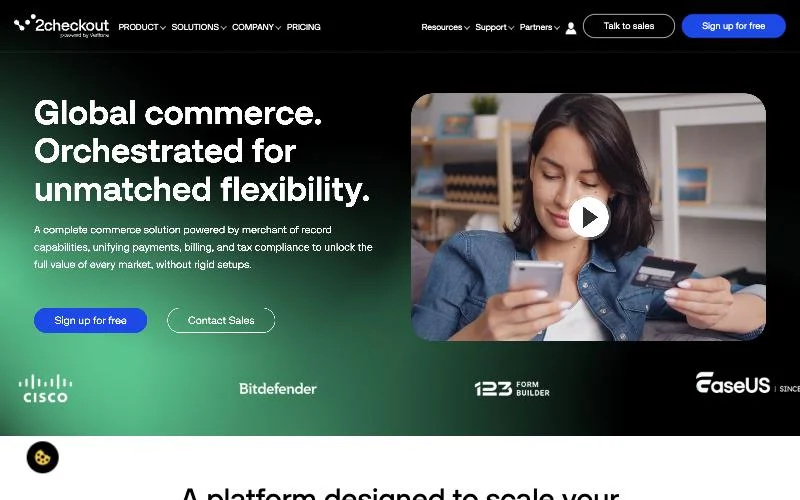
2Checkout, now owned by Verifone, has sold digital goods internationally for years and covers a lot of countries and payment methods.
It sells three tiers. According to NerdWallet and TechRadar, 2Sell is 3.5% + $0.35, 2Subscribe is 4.5% + $0.45, and 2Monetize is 6% + $0.60. TechRadar notes that global tax compliance comes with the 2Monetize tier. That matters: if you want full MoR treatment, compare against the 6% tier, not the 3.5% headline. (2Checkout's own pricing page didn't load for us, so confirm current rates directly.)
The downside is the platform's age. It's older than most options here, so test the checkout and admin tools hands-on before committing. More in 2Checkout alternatives.
8. Polar: best open-source, developer-first MoR

Polar is open source and built by developers for developers, with metered usage billing and a modern API. It also has the most granular pricing on this list. Per Polar's pricing page, the free Starter plan is 5% + 50¢, Pro is $20/month plus 3.8% + 40¢, Growth is $100/month plus 3.6% + 35¢, and Scale is $400/month plus 3.4% + 30¢.
Read the add-ons, though. International cards add 1.5%, disputes cost $15 each whatever the outcome, and Stripe payouts carry $2 per active month plus 0.25% + $0.25 per payout. For a mostly non-US customer base, the effective rate climbs quickly. Polar is also young, so B2B features like quotes and complex invoicing are thinner than at Paddle or Cleverbridge.
9. Dodo Payments: best newer MoR for usage-based pricing
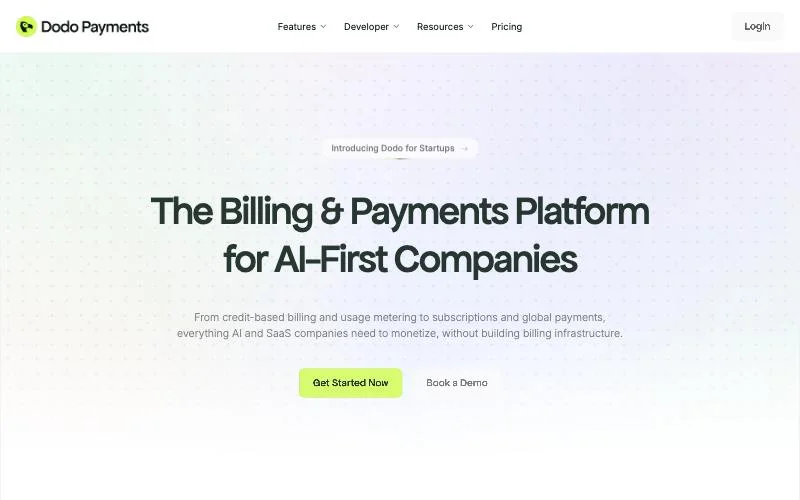
Dodo Payments builds its pitch around metered billing for things like token usage and customer credits. Dodo's pricing page lists 4% + 40¢ per domestic US card or wallet transaction, plus 1.5% for international payments, 0.5% for subscriptions and usage-based billing, and 3% extra for PayPal and buy-now-pay-later.
The base rate looks low. Stack the add-ons for a subscription paid with a non-US card and you're at 6% + 40¢, which is more than Paddle. Run your own customer mix through it before deciding. For usage-heavy products, also see our roundup of usage-based billing software.
10. Creem: best low-fee option for early-stage AI and indie products

Creem has the lowest flat rate here: 3.9% + $0.40 per successful sale, with $0 monthly and setup fees, per Creem's pricing page. Its homepage pitches it at AI products and solo founders, with usage billing, payouts and affiliates built in.
Creem is new, and that's the main risk. Feature depth for B2B (invoicing, complex tax situations, enterprise procurement) is limited, and add-on fees apply to features like revenue splits and affiliates according to Creem's docs. Our Creem alternatives post covers who outgrows it and when.
Also worth knowing: Stripe Managed Payments
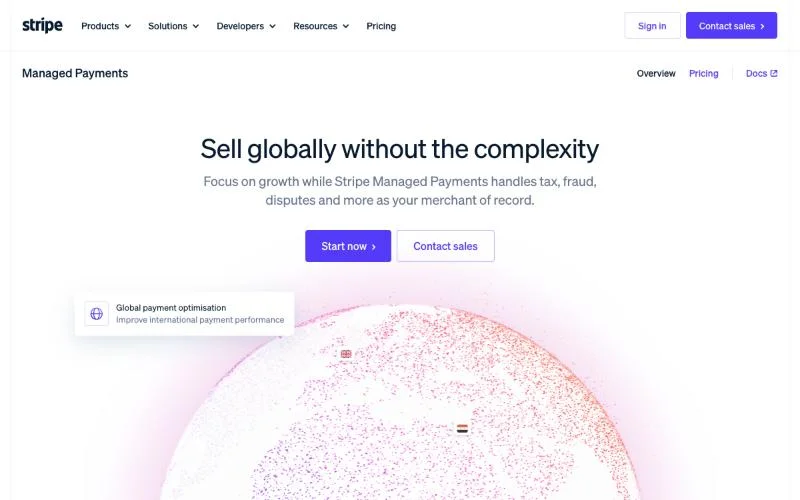
Stripe now sells its own MoR. On Stripe's Managed Payments page, Stripe says it "(via Link) becomes the merchant of record," and that the service "adds 3.5% per successful transaction to your standard Stripe processing fees." It's designed for digital products and software subscriptions and only works in supported markets. We haven't ranked it because it's new and the country list isn't published. For a team already deep in Stripe, it's worth a look. Add your normal Stripe card fee to that 3.5% before comparing it with the rates above.
How to choose a merchant of record provider
Start with your average order value, because the fixed per-transaction fee decides more than the percentage.
Under about $10k a month in revenue, setup speed matters more than half a percentage point. Lemon Squeezy, Polar and Creem are fine here, and our guide to the best merchant of record for solo founders goes deeper.
B2B SaaS that sends invoices, sells annual contracts or deals with procurement teams should shortlist Paddle and Cleverbridge, then add Comecero if you'd rather keep your own processor.
If you sell AI or API products priced on usage, check that metering is real and generally available, not a beta. Dodo, Polar and Comecero support usage pricing today, and the merchant of record for AI companies guide covers what to ask.
High average orders (say $2,000 and up) change the math again. The per-transaction fee becomes irrelevant, but approval and reserves start to matter a lot. Read what a high-ticket merchant account is before signing anything.
One opinion, for what it's worth: if two providers are within a percentage point of each other, pick the one whose checkout and support you'd trust during a bad week. The fee difference on $50k a month is $500. A broken renewal flow costs more.

What a merchant of record should cost
Take a SaaS product doing $20,000 a month at a $40 average order. That's 500 transactions, all US cards, no add-ons:
| Provider | Rate | Monthly cost | Effective rate |
|---|---|---|---|
| Paddle | 5% + 50¢ | $1,250 | 6.25% |
| Comecero Express Payments | 4.9% + $0.40 | $1,180 | 5.9% |
| Dodo Payments (with +0.5% subscription add-on) | 4.5% + 40¢ | $1,100 | 5.5% |
| Creem | 3.9% + 40¢ | $980 | 4.9% |
| Polar Pro (incl. $20/month) | 3.8% + 40¢ | $980 | 4.9% |
At a $40 order, the fixed fee adds 1–1.25 points on its own. Now raise the average order to $400 (50 transactions for the same $20,000) and Paddle drops to $1,025, Comecero Express to $1,000, and Creem to $800. Fixed fees nearly disappear, and the percentage decides.
Two caveats. Non-US cards change this table a lot (Polar and Dodo add 1.5%), so redo it with your real customer mix. And FastSpring, PayPro Global and Cleverbridge can't appear here at all because their rates are negotiated. Comecero's full plan details are on the pricing page.
Merchant of record vs. billing tools vs. payment processors
A processor (Stripe, Adyen, Braintree) moves the money, and you remain the seller. A billing tool (Chargebee, Recurly, Stripe Billing) manages subscriptions and invoices, and you still remain the seller. Only an MoR takes the seller role itself, which is why it can file the VAT return in Germany on your behalf and absorb the chargeback when a customer in Brazil disputes a charge.
The trade-off is a higher fee and less control over checkout and customer data. Our comparisons of merchant of record vs. payment gateway and merchant of record vs. payment facilitator go through the details, and what a merchant of record is covers the basics.
Frequently Asked Questions
Everything else you might be wondering about.
The bottom line
Shortlist two providers, not five. Put your last three months of transactions (order sizes, countries, subscription share) through each one's published rates or a quote, then pick the one that's cheapest on your mix and whose checkout you'd ship without changes. If you'd like a second opinion on that math, or want to see whether keeping your own processor makes more sense, talk to the Comecero team.